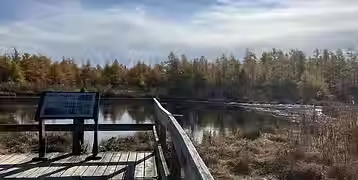
Volo Bog is the only open-water quaking bog in Illinois, and is also the southernmost open-water quaking bog in America to show all stages of bog succession.
What does that mean?
Bogs are one of the four types of wetlands. They're characterized by nutrient-poor acidic soil, the presence of peat, and water fed by precipitation rather than streams. A "quaking bog" occurs when peat, sedges, and other vegetation form a mat that floats atop the water beneath. At Volo Bog, this mat is home to tamaracks, orchids, shrubs, and many other unique plants.
Volo Bog also displays all the stages of bog succession. Ecological succession is the process by which one natural community is gradually replaced by another - at Volo, the bog is gradually filling in as the mat gets thicker. This process has resulted in five distinct vegetation zones that surround the bog's central pool, which is the only open water remaining from what was once a 50-acre glacial lake!
Volo Bog is designated as both a State Natural Area and a National Natural Landmark. These designations mark its importance on a nationwide scale.


Sphagnum & Peat: Building Blocks of a Bog
Sphagnum moss grows like a fuzzy green carpet across the floating mat. Sphagnum is highly absorbent and contributes to the wet soil conditions enjoyed by tamaracks, orchids, pitcher plants, and more.
When plants die in a bog, the stagnant, oxygen-poor water inhibits decomposition. The resulting mass of partially-decomposed vegetation is called peat. Peat is composed largely of sphagnum moss, but other plants contribute too. Areas rich in peat are called "peatlands" - most peatlands are bogs, but peat can also form in fens, pocosins, and peat swamp forests.
Some garden centers advertise peat for landscaping, but peat is a valuable carbon sink that takes a very long time to regenerate. Some alternatives include compost, composted manure, and leaf mulch.
Vegetation Zones
Volo Bog has five concentric vegetation zones arranged like a bullseye - the floating boardwalk will take you through them all to the central pool. The Tamarack, Low Shrub, and Herb Mat zones are all on the floating mat. The bog itself lies in zones 0-3 (and a bit of 4).
5. Marsh Moat This is the outermost ring of wetland, though it's not technically a bog. The marsh is dominated by cattails and wildlife such as red-winged blackbirds, sandhill cranes, muskrats, and water snakes.
4. Tall Shrub Zone The innermost part of this zone is where the bog proper begins. Dominated by winterberry holly, dogwood, poison sumac, ferns, and invasive glossy buckthorn (which our restoration team works to remove).
3. Tamarack Zone Tamaracks are a deciduous conifer, meaning their needles turn gold and drop in the fall! Volo Bog's tamarack forest has a carpet of sphagnum moss. This zone is also where you can see pitcher plants.
2. Low Shrub Zone As the mat gets thinner, plants like bog birch, poison sumac, willows, and young tamaracks take over.
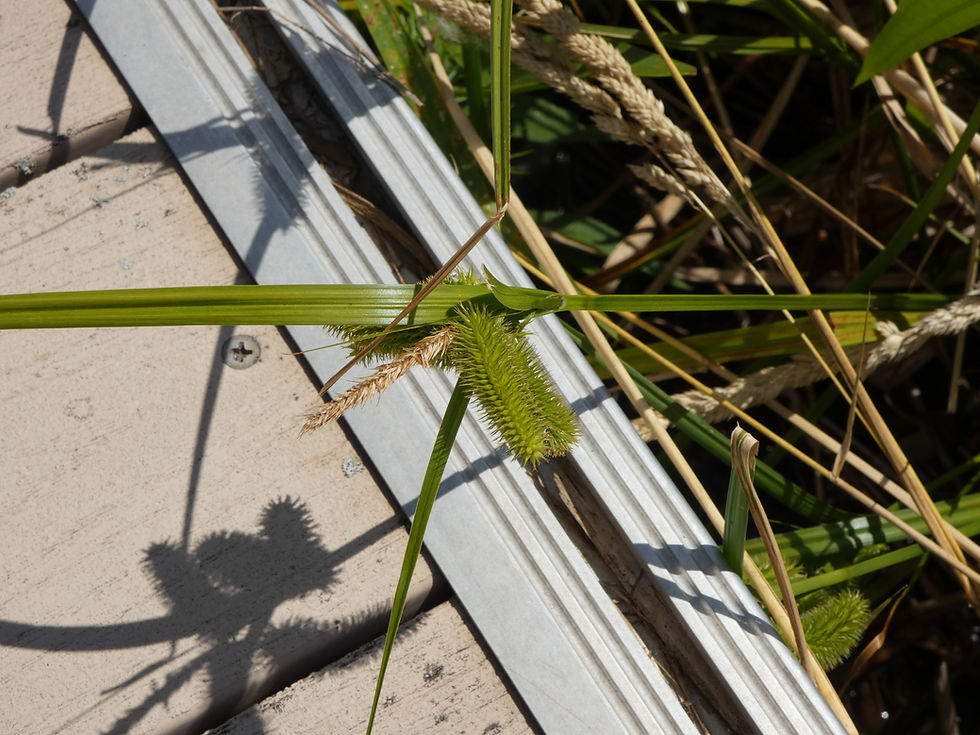
1. Herb Mat This is the thinnest part of the mat, home to leatherleaf, willows, sedges, and bladderworts. Keep an eye out for turtles swimming near the boardwalk.
0. Open Water This central pool, the Eye of Volo Bog, is all that remains of the ancient glacial lake. Due to the low oxygen content, there's no fish - look for frogs and birds instead.

Wildlife
Bogs are fragile ecosystems - no collecting of any kind is allowed at Volo Bog, either in the bog itself or in the surrounding uplands.
Volo Bog's unique habitat houses many species that are typically found further north. Different flowers are in bloom throughout the summer, ensuring there's something new to see any time you visit. The tamarack forest is a highlight - tamaracks are a deciduous conifer, meaning their needles turn gold and drop in the fall.
Some interesting fauna are sandhill cranes, red-winged blackbirds, muskrats, and minks. The bog itself is too acidic and low-oxygen for fish, so the water is inhabited by frogs, snakes, and turtles instead.
Sandhill cranes often breed onsite! Keep an eye out in spring and summer for a chance of seeing them with their chicks, called "colts". If you don't see them, you may hear them - a characteristic trumpeting call that echoes across the bog.
Remember to always keep a safe distance away from wild animals.


Volo Bog is home to two chronologs! Chronologs are a citizen science environmental monitoring program that allow you to watch a site change over time through visitor-submitted photographs. Our chronologs are located at the eye of the bog and at the bog overlook. We encourage you to submit your own photos to the logs next time you visit - every picture counts!